

The basic waterproof and anti-seepage function of waterproof coatings plays an irreplaceable role in enhancing the stability and service life of building structures in multiple fields. This article will explore in detail the role of waterproof coatings to help readers better understand and apply this building material.
- Waterproof and anti-seepage functions
The most basic function of waterproof coating is waterproofing and anti-seepage. On the base surfaces of buildings that require waterproofing treatment, such as roofs, basements, bathrooms, and exterior walls, waterproof coatings can form a continuous, integral, and thick waterproof layer. This waterproof layer can effectively prevent moisture infiltration, moisture, mold, and other water related damages.
The coating formed by the curing of waterproof coating has certain extensibility, elasticity, crack resistance, impermeability, and weather resistance, and can cope with various complex climate and environmental conditions. For example, in terms of basement waterproofing, waterproof coatings can be applied to basement walls and floors to effectively prevent groundwater infiltration and leakage problems. In terms of roof waterproofing, waterproof coatings can be applied to the roofs of various buildings, such as residential buildings, commercial buildings, factories, etc., to provide waterproof protection.
- Protecting and enhancing building structures
In addition to its waterproof function, waterproof coatings can also enhance the strength and stability of building structures. Waterproof coatings usually have good adhesion and fluidity, are easy to apply and spray, and can tightly adhere to the surface of the building’s base layer, forming a strong protective layer. This protective layer can resist external weathering, erosion, and mechanical damage, thereby extending the service life of the building.
In construction projects, waterproof coatings can also be used to compensate for and fill cement gaps. Cementitious waterproofing agent is a chemical additive that is added to cement and mixed evenly. When the cement sets and hardens, its volume expands, compensating for shrinkage and fully filling the gaps between cement. This waterproofing agent is suitable for waterproofing projects such as basements, bathrooms, reservoirs, purification tanks, tunnels, as well as roofs, ceilings, floors, walls, etc.
- Adapt to complex shapes and easy construction
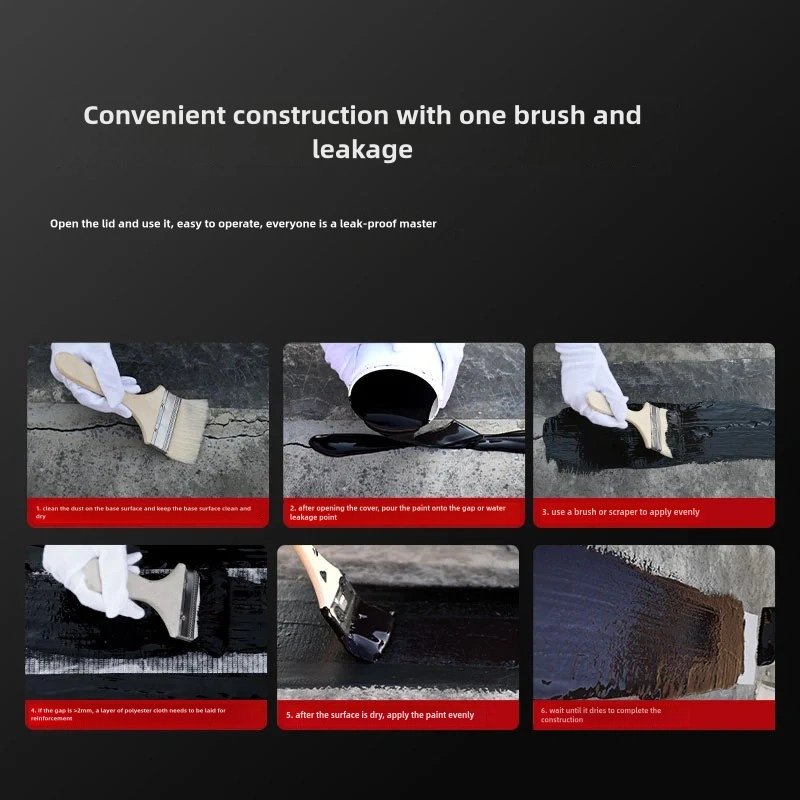
A significant advantage of waterproof coatings is their strong adaptability, which can adapt to various complex shapes of substrates such as curved surfaces, slopes, etc. After curing, the waterproof coating can form a complete waterproof coating on the surface of these complex areas, ensuring the waterproof effect. In addition, waterproof coatings are easy to apply, have low labor intensity, can be manually applied, and are flexible and convenient to operate.
The construction of waterproof coating belongs to cold work and is not limited by season and temperature, and can be carried out under normal temperature conditions. This makes the application of waterproof coatings in construction projects more extensive and flexible. Meanwhile, waterproof coatings have relatively low prices and good cost-effectiveness, making them the preferred material for many construction and decoration projects.
- Durability and environmental friendliness
High quality waterproof coatings have good durability and can maintain their waterproof effect for a long time. The waterproof coating has the characteristics of water resistance, weather resistance, acid and alkali resistance, and excellent extensibility, which enables it to adapt to the needs of local deformation of the base layer and maintain the integrity and stability of the waterproof layer. This enables waterproof coatings to effectively prevent moisture infiltration and protect the internal structure of buildings from damage during long-term use.
In addition to durability, waterproof coatings also have good environmental friendliness. Modern waterproof coatings usually do not contain harmful substances, are environmentally friendly, and safe to use. In construction and decoration projects, the use of environmentally friendly waterproof coatings can reduce pollution and damage to the environment, which is in line with the concept of sustainable development.
Widely applicable in various fields
The application fields of waterproof coatings are very extensive, covering almost all buildings and decoration projects that require waterproof treatment. In residential buildings, waterproof coatings are commonly used for waterproofing wet areas such as bathrooms, kitchens, balconies, etc., to prevent moisture from penetrating and causing problems such as wall mold and detachment. In commercial buildings, waterproof coatings can be used for waterproofing protection of roofs, exterior walls, and other areas to ensure the safety and stability of the building.
In the field of transportation, waterproof coatings can be applied for waterproof protection of buildings such as roads, bridges, and tunnels. In waterproofing engineering, waterproof coatings can be used for waterproofing treatment of basements, warehouses, underground parking lots, subway stations, tunnels, building foundations, and other areas. In addition, waterproof coatings can also be used for waterproof protection of water related facilities such as food ponds, swimming pools, fish ponds, and sewage treatment tanks.
In summary, waterproof coatings play an irreplaceable role in modern architecture and decoration. Its waterproof, anti-seepage, structural protection, adaptability to complex shapes, easy construction, good durability, environmental safety and other characteristics make it the preferred material for many construction and decoration projects.